

Payday Super 2026: Overview for Employers
Payday Super is a major change to Australia’s superannuation system, and it will affect every employer.
From 1 July 2026, employers must pay Super Guarantee (SG) contributions on each payday, rather than quarterly.
This overview explains how Payday Super works, what employers need to do, and how to prepare for the transition.
What Is Payday Super?
Payday Super is a new superannuation requirement that aligns super payments with payroll cycles.
Under Payday Super:
- Super Guarantee contributions must be paid each payday
- Contributions must be received by the employee’s super fund within 7 business days of payday
- The current quarterly payment system will no longer apply
The reform is designed to improve retirement outcomes, reduce unpaid super, and increase transparency for employees.
When Does Payday Super Start?
- Mandatory start date: 1 July 2026
- Who it applies to: All employers, regardless of size
- Early adoption: Employers can transition before this date
Employers may continue paying quarterly super only up to 30 June 2026.
How Payday Super Changes Employer Obligations
Under the current system, employers pay super quarterly. From July 2026, employers must:
- Calculate Super Guarantee on each payroll cycle
- Ensure super is received by the fund within 7 business days
- Report super obligations more frequently through payroll systems
Late payments may trigger Super Guarantee Charge (SGC) and other penalties.
Qualifying Earnings Under Payday Super
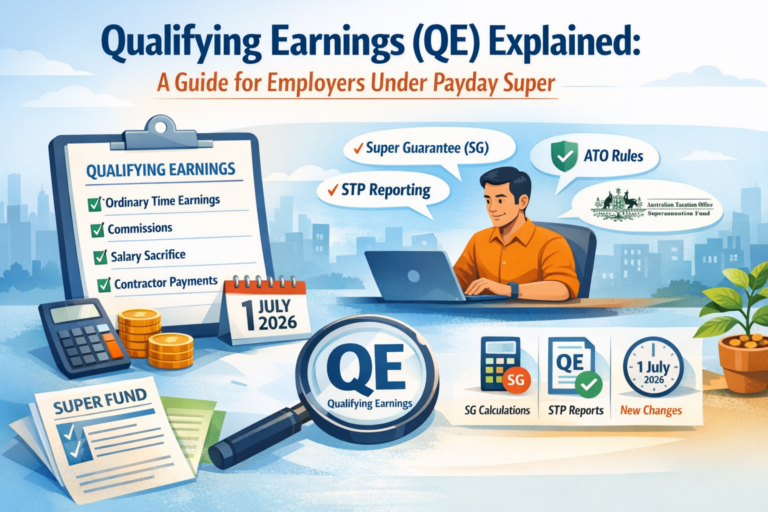
From 1 July 2026, employers must calculate Super Guarantee using qualifying earnings (QE).
Qualifying earnings include:
- Ordinary time earnings
- Commissions
- Certain salary sacrifice amounts
- Payments to some contractors paid mainly for their labour
For most employers, qualifying earnings closely align with ordinary time earnings. This means the amount of super paid often stays the same, but the timing and reporting change.
Related article: Qualifying Earnings (QE) Explained: A Guide for Employers Under Payday Super 2026
ATO Source: ato.gov.au
Super Payment Timeframes Employers Must Meet
Standard Payment Rule
- Super must be received by the employee’s super fund within 7 business days of payday
Limited Extended Timeframes
In specific situations, an extended timeframe of up to 20 business days may apply, including:
- First‑time super payments for a new employee
- Payments to a new super fund
- Out‑of‑cycle payroll runs
- Exceptional circumstances affecting multiple employers
These extensions are exceptions and do not replace the standard 7‑day rule.
Payroll and STP Reporting Changes
Payday Super introduces new Single Touch Payroll (STP) reporting requirements.
From 1 July 2026, employers must report:
- Each employee’s year‑to‑date qualifying earnings, and
- Each employee’s year‑to‑date super liability
From 1 July 2027, STP reports that do not include this information may be rejected by the ATO.
This makes payroll accuracy and system readiness critical.
What Employers Should Do Now
Employers should begin preparing well before July 2026.
Key Preparation Steps
- Review cash flow impacts of more frequent super payments
- Confirm payroll software is Payday Super–ready
- Ensure employee super fund details are accurate
- Review pay codes to correctly map qualifying earnings
- Establish processes to quickly fix payroll or super errors
Employers who currently use the Small Business Superannuation Clearing House (SBSCH) will need to transition to another provider before Payday Super begins. Please see our article 5 Easy Steps to Transition from the SBSCH Before July 2026 for more information.
Can Employers Transition Early?
Yes. Employers can adopt Payday Super before 1 July 2026.
Early transition can:
- Reduce compliance risk
- Help payroll teams adjust gradually
- Avoid last‑minute system changes
If you’re unsure about timing or cash‑flow impacts, seek advice from your tax or payroll professional.
Key Takeaways for Employers
- Payday Super becomes mandatory from 1 July 2026
- Super must be paid on payday, not quarterly
- Contributions must be received within 7 business days
- Super is calculated using qualifying earnings (QE)
- Payroll and STP reporting requirements increase