

Payday Super Quick Guide for Employers
Payday Super is coming. From 1 July 2026, Australian employers must pay superannuation on every payday — not quarterly.
This guide explains what Payday Super is, how it works, and what employers need to do now to stay compliant.
What Is Payday Super?
Payday Super is a new Australian superannuation requirement that starts on 1 July 2026. Under this law, employers must pay Super Guarantee (SG) contributions each time employees are paid, rather than quarterly.
Super contributions must be received by the employee’s super fund within 7 business days of payday.
This change is designed to:
- Improve retirement outcomes for employees
- Reduce unpaid and late super
- Align super payments with payroll cycles
When Does Payday Super Start?
- Mandatory start date: 1 July 2026
- Applies to: All employers, regardless of size
- Early adoption: Employers can transition before this date
Key Payday Super Dates Employers Need to Know
February – March 2026: Prepare and Plan
During this stage, employers should focus on understanding the new requirements and assessing readiness.
- Learn how Payday Super differs from quarterly payments
- Review cash flow and payroll processes
- Choose a transition strategy and timing
- Confirm employees’ super fund details
- Seek advice from your tax or payroll professional if needed
April – June 2026: Finalise Your Transition
This is the final preparation window before Payday Super becomes mandatory.
- Confirm your payroll software supports Payday Super
- Understand how qualifying earnings (QE) apply to your workforce
- Transition away from the Small Business Superannuation Clearing House (SBSCH)
- Pay Super Guarantee for the January–March 2026 quarter by 28 April 2026
From 1 July 2026, all employers must pay super on payday.
How Payday Super Works
Under the new legislation, employers must ensure superannuation contributions are received by the employee’s super fund within 7 business days of each payday.
This replaces the current quarterly payment system.
What Happens If Super Is Paid Late?
If super contributions are received after the required timeframe, they may be treated as late super, which can result in:
- Super Guarantee Charge (SGC) liabilities
- Loss of tax deductibility
- Additional penalties and interest
When Does the 20‑Business‑Day Extension Apply?
In limited situations, employers may have up to 20 business days to ensure super contributions are received. These include:
- First‑time super payments for a new employee
- Payments to a new super fund
- Out‑of‑cycle or irregular payroll payments
- Exceptional events affecting multiple employers
- When an extended due date overlaps a subsequent payday
These extensions are exceptions, not the standard rule.
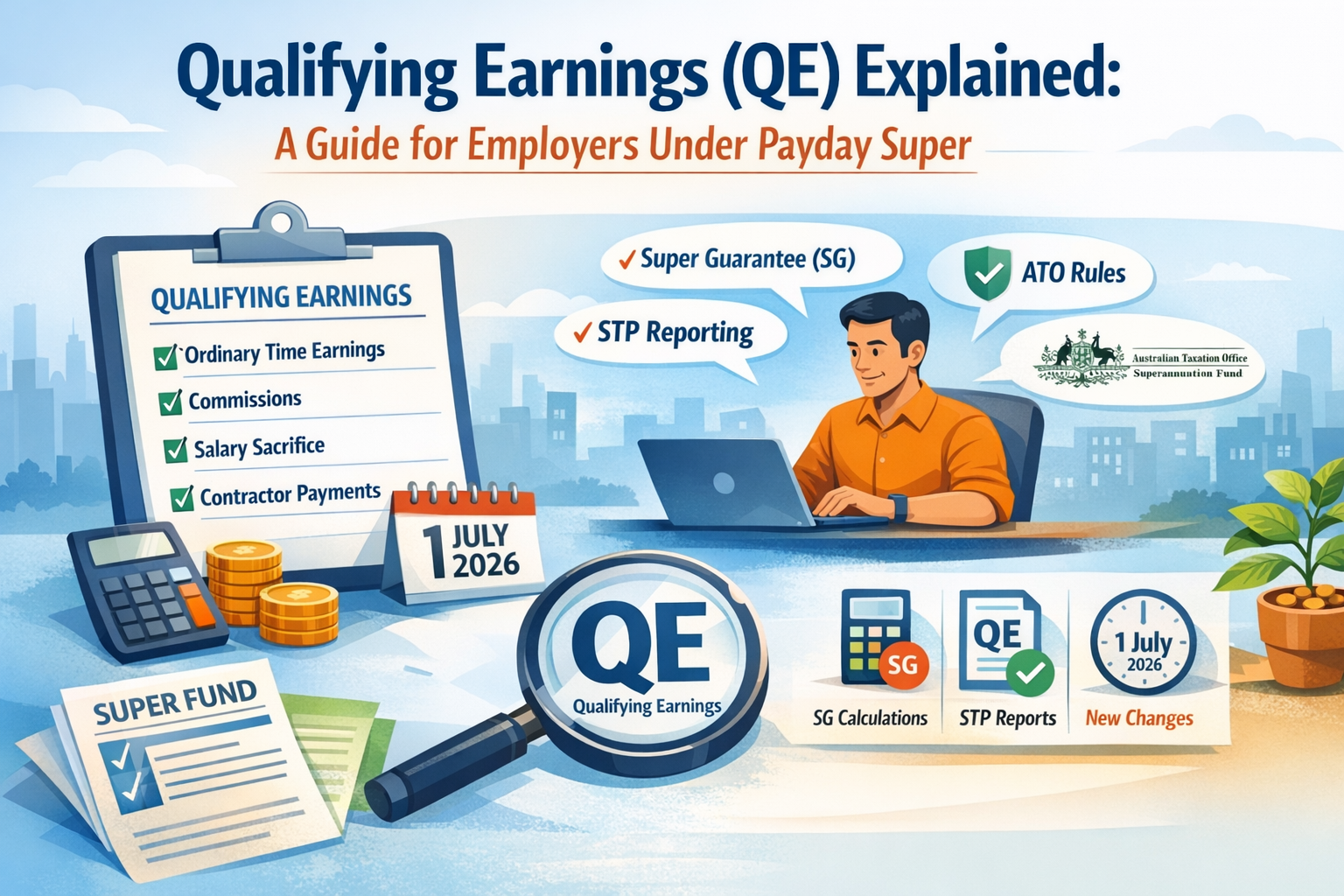
What Are Qualifying Earnings (QE)?
The ATO has introduced a new term called qualifying earnings (QE).
Qualifying earnings are the types of payments used to calculate Super Guarantee under Payday Super.
In most cases, QE closely aligns with ordinary time earnings (OTE).
This means:
- Most employers won’t pay more super
- Super will simply be paid more frequently
Learn more: Qualifying Earnings (QE) Explained: A Guide for Employers Under Payday Super 2026 (internal link)
Source: ato.gov.au
How Employers Can Prepare for Payday Super
Now is the time to begin transitioning to Payday Super. Key steps include:
- Reviewing cash flow impacts of more frequent payments
- Deciding whether to transition early
- Ensuring employee super fund details are accurate
- Testing payroll and reporting processes
Can Employers Switch Early?
Yes. Employers can adopt Payday Super before 1 July 2026.
Early transition can:
- Reduce compliance risk
- Help payroll teams adapt gradually
- Avoid last‑minute system changes
If you’re unsure how Payday Super will affect your business, speak with your tax professional for tailored advice.
Final Checklist: April – June 2026
By April 2026, employers should be locking in their Payday Super plans:
- Payroll software calculates SG using qualifying earnings
- Processes are in place to correct errors quickly
- Super contributions reach funds within 7 business days
- Alternative clearing house is arranged if exiting SBSCH
Helpful guide: 5 Easy Steps to Transition from the SBSCH Before July 2026 (internal link)
Frequently Asked Questions About Payday Super
Is Payday Super mandatory?
Yes. Payday Super is mandatory for all employers from 1 July 2026.
Can I still pay super quarterly in 2026?
Only until 30 June 2026. From 1 July 2026, super must be paid on payday.
Does Payday Super increase super costs?
In most cases, no. The amount of super remains the same — only the timing changes.
What happens if I miss the 7‑day deadline?
Late payments may trigger Super Guarantee Charge (SGC) and penalties.